The Magus Senate of Dalaran is a heavy roleplay guild on Moon Guard (US), active since December 20, 2012.
We are scholars, investigators, healers, and defenders — united in service to arcane knowledge and the
safety of Azeroth's people. Following the destruction of Dalaran in The War Within, we operate
as a mobile institution, carrying the Senate's mandate wherever it is needed.
13+
Years Active
10
Ranks
4
Divisions
The Council Convenes
Guardians of Arcane Order
The Kirin Tor — scholars, magi, and statesmen united by duty to the arcane.
Ready to serve?
Applications are processed through our Discord server via our intake bot.
All are welcome — whether you are a seasoned roleplayer or entirely new to the craft.
The Magus Senate of Dalaran is one of Moon Guard's longest-running Kirin Tor guilds, active since December 20, 2012.
We are a heavy roleplay community built around arcane scholarship, investigation, healing, and the defense
of magical knowledge — with a focus on character-driven storytelling and collaborative worldbuilding.
Our Mission
Where once the Kirin Tor governed from the floating city of Dalaran, the Senate now operates as a mobile institution —
carrying its mandate wherever arcane threats, political crises, or humanitarian need arise. We are not merely
adventurers. We are an organization: structured, purposeful, and accountable to one another and to the world.
Members of the Senate choose a division that reflects their character's focus — whether that is deep academic
research in the Collegium, field operations and arcane law enforcement with the Vanguard,
restorative and herbal work in the Conservatory,
or administrative service in the Chancellery. Advancement through the Senate's ranks is earned
through engagement, participation, and demonstrated commitment to the guild's values.
What to Expect
Heavy Roleplay
All guild events, storylines, and interactions are conducted in-character.
Members are expected to maintain a character suitable for the Kirin Tor setting.
A Legislative Body
The Senate functions as a genuine legislative organization in-character. Members vote on legislation,
submit resolutions, and contribute to active parliamentary roleplay.
Collaborative Stories
Players are encouraged to pitch their own arcs, participate in officer-run campaigns, and develop
their characters within the Senate's structure.
Structured Progression
Ten ranks across three service tiers. Advancement is meaningful, visible, and tied to your participation
and contributions to guild life.
A chronicle of the Magus Senate of Dalaran — from its founding on December 20, 2012 through the fall of the Violet City and beyond.
Mists of Pandaria (31 L.C.)
Founding
The Magus Senate of Dalaran was founded on December 20th, 31 L.C., conceived as an accessible institution of
Kirin Tor governance — a body capable of engaging directly with the broader community of magi and citizens
while upholding the principles of arcane scholarship, order, and the responsible use of magic. In its earliest
months the Senate focused on building relationships, establishing its academic programs, and conducting early
campaigns against remnants of the Scourge and the forces of the Thunder King. The first Chancellorship was
defined by diplomacy and the laying of institutional foundations.
Mists of Pandaria — Warlords of Draenor (31–34 L.C.)
Growth & the Ministerial Era
In the years that followed, the Senate matured into one of Dalaran's most structured civic institutions.
A full ministerial apparatus took shape: the Ministry of Academics, Ministry of Security, Ministry of the
Interior, and Ministry of Foreign Affairs each developed their own departments and internal hierarchies.
Weekly Senate Sessions — formal parliamentary proceedings — became the body's defining tradition. Academic
classes, creature exhibitions, magical symposiums, and civic events ran alongside this administrative
structure throughout the era.
The Senate campaigned alongside Alliance forces during the Siege of Orgrimmar and later deployed through the
Dark Portal into Draenor. When the Portal went dark and much of the Senate's leadership was presumed lost,
the institution's continuity was tested — and held. Acting leadership maintained order until the missing were
recovered, and an orderly transition of power followed. The Kirin Tor's first extra-Azerothian settlement,
Kirin'Var Village, was commemorated annually during this period, connecting the Senate's traditions to the
Kirin Tor's longer history of expansion and loss.
Legion — Battle for Azeroth (35–38 L.C.)
Crisis & Continuity
The Burning Legion's assault on Dalaran was among the Senate's most active periods. The organization served
through the defense of the Violet City, the campaigns of Suramar, and the push against the Tomb of Sargeras.
The Senate's academic tradition continued unbroken — the monthly Creatures Exhibition ran as the institution's
longest-standing recurring class. Through the Fourth War that followed, the Senate continued to grow, though
the prolonged conflict and extended operations eventually tested even the most resilient among its leadership.
Across two Chancellorships, the Senate emerged from this era demonstrably stronger than it entered.
Battle for Azeroth — Dragonflight (38–46 L.C.)
Renewal & Statecraft
Beginning in 38 L.C., the Senate entered a period of deliberate institutional strengthening. A strategy
address in 42 L.C. laid out explicit priorities: securing Dalaran's position in Lordaeron, closing trade
agreements with allied factions, expanding the academic program, and deepening diplomatic relationships
across the Alliance and beyond.
The Shadowlands crisis forced the Senate's scholars into territory that conventional arcane theory had
never mapped — questions of death, cosmology, and the structure of Azeroth's afterlife. Operations on
Azeroth continued in parallel, with the Senate's intelligence apparatus maintaining active collection
programs throughout. The rediscovery of the Dragon Isles opened new avenues of research: by 46 L.C., the
Collegium was tracking what appeared to be arcane smuggling operations in the Isles, and the Senate's armed
forces had filled all three branch-commander billets for the first time. A Treaty of Amity with the restored
Kingdom of Gilneas marked a diplomatic milestone for the institution.
The War Within (47–48 L.C.)
The Fall of Dalaran & Reorganization
In the weeks before the Nerubian assault, the Senate was operating at full capacity: active treaty
negotiations, an Academics department investigating Dragon Isles smuggling, a State Security apparatus
assessing global flashpoints, and a Foreign Affairs ministry closing trade deals and working toward
accession to the Daubaine Convention. The Nerubian attack ended all of it without warning. When Dalaran
fell, the Senate lost members, colleagues, and the city that had been the material anchor of its identity
for over a decade.
The Senate's response was institutional. A formal state memorial service was convened at Ambermill Hall —
the organization's new operational base — on September 8th, 47 L.C. Eulogists addressed the assembled
Senate. A roll of the dead and missing was read. A candlelight vigil was held in Ambermill Square. The
service closed by placing the destruction of Dalaran within its own history — Archimonde had destroyed
the city once before, and it had risen again. The closing words became the Senate's statement of resolve:
"Unbroken still — For Dalaran."
The reorganization followed. The ministerial model that had served the Senate for over a decade gave way
to a leaner structure suited to an institution without a fixed home. Four divisions replaced the old
ministries: the Collegium, Vanguard, Conservatory,
and Chancellery. A deliberative leadership council — not tied to specific divisions —
replaced the former officer hierarchy. The Envoy system replaced standing foreign affairs bodies with
flexible, appointment-based representation. The Senate had changed its shape. Its purpose had not.
Chancellors of the Magus Senate
All those who have held the office, in order.
Chancellor
Term
Notes
I Verus Baelheit
31 L.C.
Founding Chancellor. Resigned; continued as Minister of Arcanum.
II Damon Halliwell
31–35 L.C.
Co-founder. Longest-serving Chancellor. Resigned.
— Vorien Dawnstrider
34 L.C. (acting)
Acting Chancellor during Halliwell's disappearance. Stepped down upon Halliwell's return.
III Zanbor Emerson
35–36 L.C.
Elected October 10th, 35 L.C. Retired.
IV Hellissa Brisby-Pyrestaff
36–38 L.C.
Elected November 19th, 36 L.C. Expanded the Academics program. Retired.
V Salazar Demes
38 L.C. — present
Elected April 20th, 38 L.C. Incumbent. Led the post-Dalaran reorganization.
Historical Reference
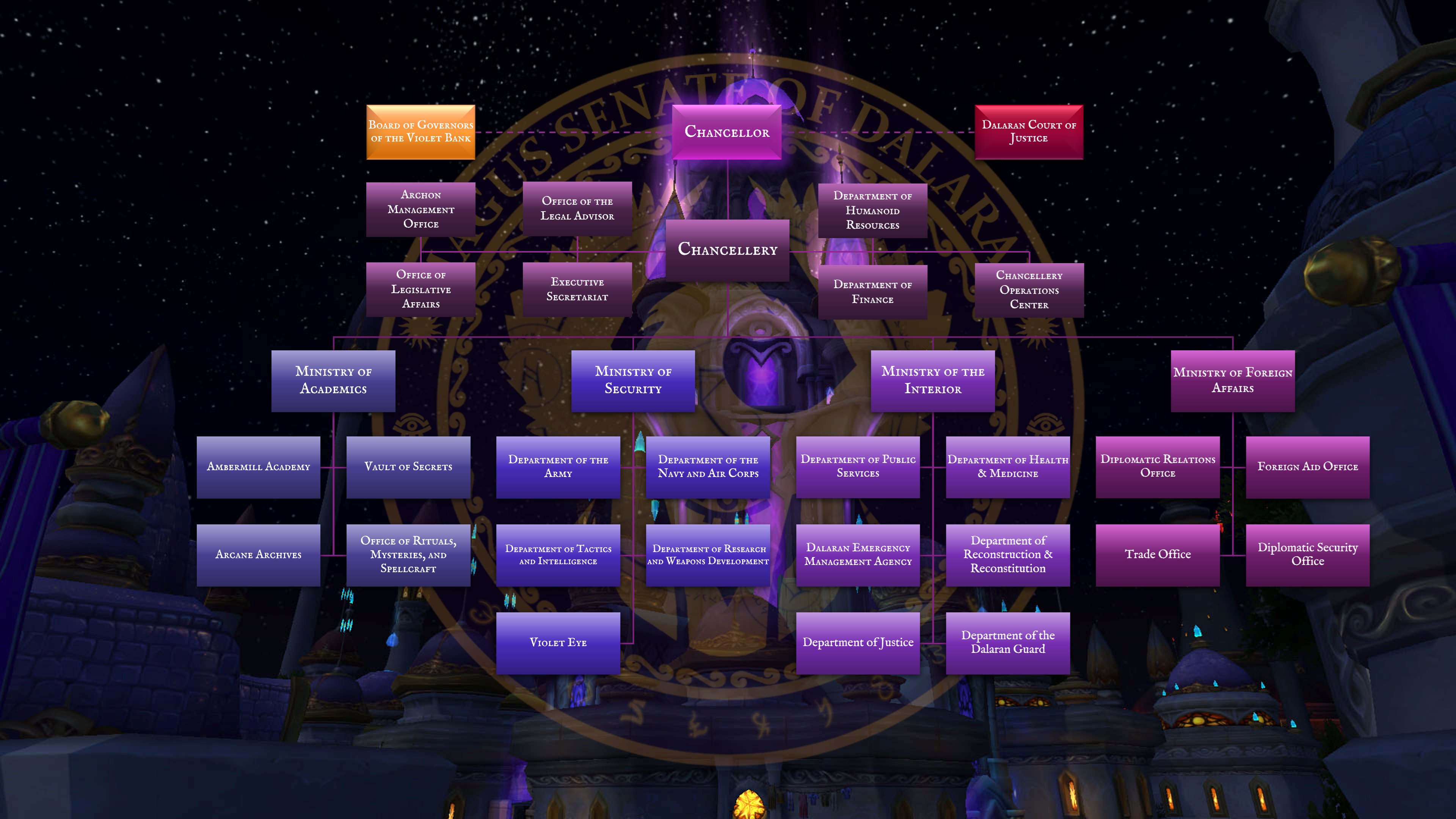
The Ministerial Structure (Pre-Reorganization)
The organizational chart below reflects the Senate's structure as it existed through October 2025, prior to the
post-Dalaran reorganization. It is preserved here as a record of the guild's history.
Code of Conduct
Rules of the Magus Senate
Membership in the Magus Senate of Dalaran is a privilege. The following rules govern conduct within the guild,
on our Discord, and in any public space where members represent the Senate.
Ignorance of the rules is not an excuse for violating them.
General Conduct
Rule I
Respect All Members
Treat all members of the Senate — and the broader community — with basic respect. Personal attacks,
harassment, and targeted hostility toward other players will not be tolerated, whether in-game,
on Discord, or in public channels. Disagreements happen; how you handle them defines your character
more than any rank.
Rule II
No Drama, No Gossip
The Senate has zero tolerance for out-of-character drama. Do not bring interpersonal grievances
into guild channels. Do not spread rumors about other members. If you have a genuine conflict with
another member, bring it to an officer privately.
Rule III
Maintain a Kirin Tor-Appropriate Character
All characters in the Senate must be plausible within a Kirin Tor context. Characters should be
capable of arcane understanding at some level — whether as a spellcaster, scholar, investigator,
or allied supporter. Advancement to the Senior Magocratic Service requires a mage character.
Lore-edge cases require officer approval.
Rule IV
Stay Active
Members who are absent for 30 days without notice may be removed from the roster or demoted.
Inactive members of the Senior Magocratic Service will be demoted to Senior Senator, except in
special circumstances. If you need to take a break, post in the absence channel on Discord.
We understand life happens — we simply ask for communication.
Roleplay Rules
Rule V
Consent in Roleplay
Consent is mandatory for any roleplay involving violence, romantic themes, character death, or
permanent consequences. Never assume another player's character will accept something extreme
without asking OOC first. When in doubt, ask.
Rule VI
No Lore-Breaking Characters
Characters must be grounded in World of Warcraft lore. We do not permit characters claiming to be
major lore figures, relatives of major lore figures without careful approval, immortal demigods,
characters from other universes, or any concept fundamentally incompatible with the setting.
Use common sense and ask an officer if you are unsure.
Rule VII
Mature Themes
The Senate follows Moon Guard server rules regarding mature content. Explicit content must be kept
out of public guild channels. Dark themes are permitted in storytelling with appropriate warning
and consent; gratuitous or shock-value content will be asked to stop.
Character Restrictions
The Senate is open to characters from a wide variety of races and specializations, provided they have
sworn allegiance to the Kirin Tor and a plausible connection to our organization. The following
restrictions apply to all members.
Rule VIII
Forbidden Magics
The following schools of magic are strictly forbidden in-character without prior officer approval,
and only in extraordinary circumstances: Fel, Necromancy, Shadow/Void, Blood, and Drust.
For further detail, see the Forbidden Magics Act in the Laws of Dalaran.
Rule IX
Restricted Character Classes
The following character types may not join the Senate:
Demon Hunters — neither IC nor OOC.
Dragons — IC characters.
IC Warlocks — Warlock players may join if their character is an IC proxy for a mage or similar.
IC Death Knights (and other necrotic-based classes such as San'layn) — Death Knight players may join if their character is an IC proxy for a mage or similar.
OOC Warlock and Death Knight proxies must use non-Fel or non-Necromantic spells in any combat-based events
(e.g. fire spells for Warlocks, frost spells for Death Knights). Characters who develop into IC Warlocks
or Death Knights — through retcons, deaths, or resurrections — will have their affiliation immediately
terminated. These characters may not wear Warlock or necromancer-style transmog and must maintain
living, healthy physical appearances.
Rule X
Void Elves (Ren'dorei)
Due to canonical lore, Void Elves cannot join the Kirin Tor. However, Void Elf players may join
the guild if their character is roleplayed as a High Elf or Blood Elf (Quel'dorei or Sin'dorei),
with appropriate skin tones and hair options for their respective race.
Rule XI
Horde Characters
Horde characters are welcome to join the Senate as Kirin Tor members, consistent with the
Kirin Tor's canonical position of neutrality and its history of accepting members from both factions.
Discord & Community
Rule XII
Use Channels Appropriately
Each Discord channel has a stated purpose. Keep conversations relevant to the channel.
Do not spam, flood channels, or post irrelevant content during active discussion.
Rule XIII
No Unsolicited Recruitment
Do not recruit for other guilds in Senate spaces. Do not use your membership to poach members
for competing organizations. This applies both in-game and on Discord.
Rule XIV
Officer Decisions Are Final
Officers have the authority to make binding decisions on guild matters. If you disagree with a ruling,
bring it to the Chancellor privately. Do not relitigate it in public channels.
We are not a democracy, but we do listen.
Enforcement
Violations may result in a warning, temporary suspension, or removal from the guild depending on
severity and pattern. These rules are not exhaustive — officer judgment applies in situations not
explicitly covered here.
Organizational Structure
The Senate's Structure
Ten ranks across three service tiers, four divisions, and a flexible Envoy appointment system.
This structure reflects the Senate's post-Dalaran reorganization.
Rank Hierarchy
From highest to lowest. Click any rank to expand details.
Divisions
Members choose one division upon achieving full membership. Division changes require officer approval.
The Envoy System
Recruitment
Joining the Magus Senate
The Senate is open to new members throughout the year. We accept characters from all races
with a plausible connection to arcane scholarship or Kirin Tor service. Applications are processed
through our Discord server.
How to Apply
Join our Discord server.
All applications begin in Discord. Use the link at the top of this page to join.
You will be assigned a guest role upon entry.
Review the rules and structure.
Before applying, familiarize yourself with our code of conduct
and organizational structure. Knowing what you are joining helps
us find the right fit for your character.
Submit your application via the intake bot.
Use the designated application channel in Discord to submit through our intake bot.
You will be asked for basic character information and a brief background.
An officer will review your application.
Officers review all applications and may reach out with clarifying questions.
We aim to respond within a few days.
If accepted, join us in-game.
Accepted applicants will be invited in-game and join as a Junior Senator.
Welcome to the Senate.
Requirements
Server & Faction
Moon Guard (US). Both Alliance and Horde characters are welcome as Kirin Tor members, consistent with the Kirin Tor's canonical neutrality.
Character Concept
Your character must have a plausible connection to the Kirin Tor or arcane service. Mage characters are required for advancement into the Senior Magocratic Service. See the Rules page for class and magic restrictions.
Roleplay Experience
Some familiarity with WoW roleplay is helpful but not required. We welcome newer roleplayers willing to learn.
Activity & Meetings
Guild Senate Meetings are held on the second Sunday of each month at 7:00 PM server time. Please ensure you can attend before applying. Additional division events occur throughout the week.
Required Addons
The following addons are required for membership. They enable proper roleplay profiles, emote formatting,
and spell-check for emotes.
Questions? Reach out to any officer on Discord or whisper an online member in-game. Walk-up roleplay is welcome — we encourage prospective members to interact with us in character first.
Lore & Codex
The Arcane Record
A repository of lore relevant to the Magus Senate — the history of the Kirin Tor, the nature of
our practices, and the context in which we operate. This codex is a living document.
The Kirin Tor
On the Order of the Kirin Tor
The Kirin Tor is the ruling council of mages that has governed the city of Dalaran for millennia.
Founded to study and regulate the use of magic across Azeroth, the Kirin Tor is perhaps the most
powerful organization of spellcasters in the world — a body that has weathered the Second War,
the rise of the Lich King, the Cataclysm, the Legion's final assault, and countless crises in between.
Their sigil is the eye. Their colors are violet and gold. Their purpose: to preserve, study, and
responsibly wield the arcane arts for the betterment of all.
Senate Doctrine
The Senate's Mandate
The Magus Senate operates under what its members call the Mandate of the Violet Eye —
an informal doctrine that has guided the organization since its founding. In its simplest form,
the mandate holds three obligations:
Preserve — knowledge, life, and magical order wherever they are threatened.
Investigate — threats to the arcane order must be understood before they can be contained.
Respond — the Senate is not an ivory tower. When the world needs action, we act.
The destruction of Dalaran reinforced rather than diminished this mandate. Without a home city,
the obligation to respond has become the Senate's defining characteristic.
The Parliamentary Tradition
Governance & Legislation
The Senate governs through an active legislative process. Members submit resolutions and legislation,
vote on parliamentary matters, and participate in formal sessions that reflect the Kirin Tor's
tradition of governance by council. The Civil Service — Junior Senators, Senators, and Senior
Senators — forms the core of this legislative body.
The Chancellor holds executive authority, but the Senate's identity is fundamentally
collaborative. Legislation emerges from the membership, and the Senate's direction is shaped by
those willing to engage with its process.
The Envoy Tradition
Envoys of the Senate
Since the Senate's earliest days, individual members have been dispatched as formal representatives
to allied factions, foreign courts, and distant locations. The Envoy appointment carries with it
the authority to speak in the Senate's name in that specific context.
Modern Envoys are tracked by the Chancellery and appointed by the Chancellor.
An Envoy carries no new rank — their authority is defined by their posting and the scope of their
mandate, not by a place on the hierarchy.
Lore Standards
The Lore Hierarchy
The Senate generates fan-fiction to supplement the lore of World of Warcraft. Where interpretations
differ, members are expected to follow this hierarchy of precedence:
Canonical Lore — Lore declared canon by Blizzard.
This includes in-game quest text, novels, the World of Warcraft website, and official developer answers.
Decanonized Lore — Lore established by Blizzard that has since been declared non-canon,
provided it does not contradict canonical lore. (e.g. the Warcraft: The Roleplaying Game sourcebooks.)
Guild Lore — Fan-fiction established through the Senate's own campaigns, events, and meetings.
Realm Lore — Fan-fiction from recognized projects and guilds on the Moon Guard server.
Other — Other works of fan-fiction, whether from World of Warcraft, D&D, Tolkien, or elsewhere.
Members are not expected to enforce this hierarchy on players outside the guild. It is an internal
standard for resolving lore disputes and guiding creative decisions within Senate roleplay.
Contribute to the Codex
Members are encouraged to submit lore pieces, character histories, and in-world documents for inclusion.
Reach out to an officer on Discord.
Official announcements, event notices, and updates from Senate leadership.
For real-time discussion, join us on Discord.
April 2026
Senate Reorganization Complete
Following the events of The War Within and the fall of Dalaran, the Magus Senate has completed
its structural reorganization. The new four-division model — Collegium, Vanguard, Conservatory,
and Chancellery — is now in effect. The Chancellor's Council replaces
the old ministerial structure. All members are encouraged to review the updated structure and declare
their division affiliation.
Ongoing
Recruitment Open
The Senate is actively recruiting across all divisions. If you are interested in joining or know
someone who might be a good fit, direct them to our Discord or to the
How to Join page.
This page is updated periodically. For live announcements, join our Discord.